Showing posts with label England. Show all posts

Wednesday, June 22, 2011

Exploring with a Camera: Thresholds (2nd edition)


[Author's Note: Through the summer months Exploring with a Camera will be "Second Edition" postings of previous explorations with some new images. You will find a new link up at the end of this post to share your photos, and your photos are also welcome in the Flickr pool for the opportunity to be featured here on the blog. I hope that you will join in!]


Time for another exploration! This time of a subject: Thresholds. By "threshold" I'm not referring to any technical term, but a physical place. A place where you cross over, from one locale to another, whether real or imagined. Threshold images are not merely images of doors or gates, but they are of portals that transport you to somplace different in your imagination.

The photo above is an example of the type of "threshold" I am talking about. This image is from the Roman Arena in Verona. When I look at it, I get a sense of time travel. In my imagination, if I walk through that curtain, I will be transported back to Roman times. There is a magical quality of the unknown on the other side of that curtain. It beckons me to come through.

Here is another, of a gate to Parco di Monza near my home. This image gives me the feeling of looking into another world, some sort of magical winter wonderland. The gate is merely the portal, the threshold to this place. I want to explore down that path.


And here is a threshold that I captured that has become sort of an anti-threshold to me. One that I don't plan to pass through. You see, later this year [2010] I turn 40 years old and I started looking for places with the address 40 to capture my threshold. This image is from the island of Murano in the Venetian lagoon, one of my favorite places on earth to photograph, but this is one of the most depressing images I have photographed there. After I reviewed and edited it, I realized that is not my 40 threshold at all - there is no hope, no happiness, no creativity in this threshold. It's pretty bleak and closed off. It showed me that I have no problem with turning 40, that I reject the idea that this milestone is a bleak thing. So there is power in that too - I began to imagine what my internal 40 threshold looks like and it's nothing like this.


To capture a special threshold image, here are some tips:

1. Look for doors or gates that have some contrast in what is behind versus what is part of the wall or structure the opening is in. This could be a contrast in light or in scenery. The greater the contrast, the greater the opportunity for the "threshold" feeling.

2. Try getting in close to the threshold. By cropping in close on the opening so you don't see what is surrounding it, you create more opportunity for creative story telling because there is not as much physical "place" presented to distract the imagination with reality.

3. Look for openings that are not fully open, that just give a hint of what is behind them. This will give a tantalizing, magical feeling. In this case, the imagination is not distracted by the reality of what is on the other side of the threshold, but is allowed to go wild.

4. Look for thresholds that have meaning to you, whether it's the address number or the physical place or the imagery you find there. Later, take some time to examine that image to see what meaning you find. Does the image match your imagination or feelings? Why or why not? Can this threshold be useful to you to learn something about yourself?

Photography, like any art, is symbolic. The images we capture have meaning, whether or not we know it at the time. Explore the world around you with the idea that there are magical thresholds available to you all the time, and share what you find!

Update: I am always capturing images of doors, but capturing a threshold is a different and special thing. The lead-in image is from the Do What You Love retreat I attended in May, and for me it embodies the magical feeling of creative safety and warmth found at the retreat. 


I also want to share another special threshold image I captured later in 2010, after I wrote this original post. You see, I found my "40" threshold. In a small village in the English countryside, this threshold is similar to the image I created in my head for my "40" threshold: A cozy, welcoming cottage with a gate and rose garden out front. Amazing, huh?


FYI - Links will be moderated. Please use a permalink, ensure that your linked image is on topic, and include a link back to this site in your post through the Exploring with a Camera button (available here) or a text link. Thanks!

Monday, May 16, 2011

Doing What I Love...


Imagine spending five days in the gorgeous Yorkshire countryside, eating your meals in a tipi around a fire.


Staying in wonderful cabins, that feel like part of the surrounding forest, with the best cabin-mates ever.


Sleeping in a heavenly bed, in a room where the art is the natural world outside the window.

Juliette and Carissa
Meeting the most amazing people from all over the world. We didn't know each other, but found instant connections. I felt like I had known these wonderful women my whole life.

Tara
Learning to paint from my intuition with the most amazing artist and teacher, Flora Bowley. Learning to go with what's working, to go bold, to let go of attachment to a specific outcome and see what happens.


Finding my heart, in the midst of it all.

I got back late last night from the Do What You Love retreat, and I'm still processing all that went on. It was so, so wonderful! I will share more over time. Over the next few days I'll be getting caught up on the Liberate Your Art Postcard Swap, adding new participants to the link list. The swap is now at 172 participants - so close to my goal of 200 - thank you all for your help!! I will also be visiting the many people who have linked in to Exploring with a Camera: Visual Contrast in the last few days, you still have a day or two to link in if you would like to share your image. 

I'm full to bursting with all of the positive energy that happens when you get 40+ people together, all doing creative things they love. Who knows what will come out next...

(Linking in to The Creative Exchange and Creative Every Day today.)

Wednesday, April 6, 2011

Exploring with a Camera: Waiting to Click

Exploring Patience in Photography 3


Welcome to Exploring with a Camera! This next couple of weeks we are going to be Waiting to Click. As always, I have a lot of ideas to share with you in this post and then there is a link up at the bottom for you to share your images on the topic. You can also share your photos in the Flickr pool if you are interested in being featured on the blog.

There is so much of our world that is changeable. When you tune in to it, you begin to notice the ebb and flow of life around us. "Waiting to Click" is about being aware of the changeable things in our environment, predicting what is going to happen and then waiting to capture the image we've anticipated. So often photographers talking about being ready, having the camera with us and available to shoot, in order to capture a fleeting moment as we see it unfold. Waiting to Click takes the readiness a bit further, adding a bit of both prediction and patience into the mix.

To get a great image by Waiting to Click requires your active participation. Here is what you have to do:
  1. Be aware of what is changeable in your environment. We live in a world of change, whether it's the flow of traffic or the clouds blowing by, there are variables that affect the potential for us to make good images. By noticing the things that are moving and changing, and how they change relative to the things that are fixed, we can make use of them in our photography.
  2. See the image you want to capture. You need to see the potential shot. This may mean looking through or past the changeable things in the environment, or predicting their behavior to include them in the image you want to capture. 
  3. Know your equipment. In order to take advantage of a changing situation, you have to know your camera. What is the delay between shutter press and release? What is the timing if you use burst? I know we are talking about fractions of a second here for dSLRs, but those fractions of a second may matter. For point-and-shoots or phone cameras, the delay is longer and you really have to be able to coordinate the pressing of the shutter with the prediction of the shot.
  4. Wait for the shot to unfold, then capture it. This is the key. This could mean waiting for several seconds, or it could mean waiting minutes. Professional photographers might wait all day for the perfect light to capture the image they see. How long you are willing to wait is up to you.
Now let's see a few examples of Waiting to Click, to further explain what I mean...

Moving Vehicles


Vehicles of all sorts are always moving around us, when we are out and about in the streets. You may recognize the lead-in image for this post as another in my emerging market/wheels series, and the capture of this shot is a great example of Waiting to Click. I saw this image across a very busy street in Siracusa, Sicily. I paused for a while and watched the traffic flow. There were a few moments in each traffic light cycle, where the cars passing by on the street cleared out just long enough to photograph a few frames. While traffic was going by, I looked at possible angles and compositions, and situated myself in the best spot for the image I envisioned. I waited for the next traffic light cycle, and the moment the cars cleared out, I got the shot.

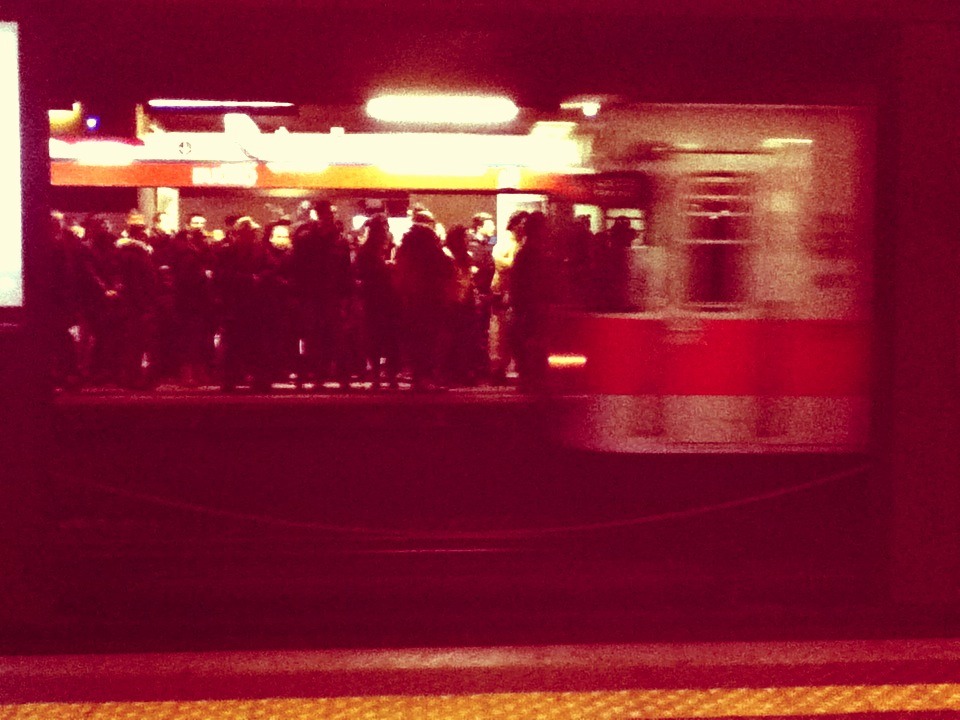
In some cases, you want the moving vehicle in the shot, like this one of the Milan subway I captured with my iPhone camera. This was my first outing with the camera, and I was just getting used to the delay. I was fascinated by the crowd on the other side of the subway platform and thought it would be a great shot to have the crowd behind the train pulling into the station, so I practiced with a couple of shots of the crowd to get the framing and camera timing down. Then, when I heard the train coming, I was ready to click as soon as it entered the frame and captured the image I wanted.


The light this particular evening in the Venetian Lagoon was spectacular. I took several images of the sky but knew the shot would be more interesting with a boat in the foreground. I had my exposure and composition dialed in, it was just a matter of waiting for the right opportunity to come along. When this boat came by, I was ready and waiting to click.


People


We are often surrounded by our fellow human beings, and depending on the shot you want, that can be a good thing or a bad thing. You might think that Europe is an empty place, from my photographs. I really love to capture an empty street or place, to allow the viewer room to imagine themselves in the frame. To do this, I often have to wait for a lull. Just like cars, the flow of people will change, but it's less predictable. Here is another in my market/wheels series, captured in Bologna. It looks like this was a deserted street, but this was a busy Saturday afternoon, the weather was nice, and people were out on the streets in force. I used the times when there were people coming by to set up the shot and play around with composition. When I found the image I wanted, I waited for the people to leave the frame, and clicked.


Here is another image where I waited for the frame to clear, with the exception of the people seated on the left. Evening at the Roman Baths in Bath, England is certainly quieter than the day, but there were still many people wandering around and listening to their audioguides. (I've learned to dislike audioguides - people stand immobile for minutes on end gazing at something while listening to the commentary, much longer than they do without the audioguide.) Meanwhile, I patiently waited for them to move on so I could get the right image. 


Often, your image will be enhanced with a person or two in just the right spot. The next two examples, from Cinque Terre and Bath, are images where the mood is further conveyed by the people in the frame. In both cases, I had to wait until the subjects walked into the right light to capture the image.


So far I've shown you empty or mostly empty places - what about crowds? I've learned quite a bit about photographing a crowd over the last couple of years. Capturing a crowd can convey the energy, the hustle and bustle of a place, but it has to be done right. In general, I've discovered that for a good crowd shot, you want to have full bodies - partial people walking into the frame or cutting off feet is distracting. For a generalized crowd, you also want the people to either be small enough their faces aren't easily distiguishable or facing away from the camera. Nothing attracts the human eye quite as much as a face, so your crowd shot can become an unintentional image of a specific person if you're not mindful. Here's a comparison of two images within moments of each other in Madrid. The first shot is one I would consider a nice crowd-in-the-street scene, the second has more crowd distractions.


Crowds ebb and flow, which is a great thing. Unless you are in an insanely crowded place (like Venice at Carnevale), you can usually situate yourself in a good location and wait for the crowd to disperse itself in a way that works for your intended image. This example from Venice (not during Carnevale) was one where I waited for a good crowd position before pressing the shutter.


The Natural Elements


So far I've talked about human elements, but natural elements - such as light and wind - are some of the more changeable features in our world. As photographers, we live for light, so being aware of the light you are working with and how it may change is an important skill. Partly cloudy and windy days can be great days for waiting to click.

The following set of images from Stonehenge show how just a few moments difference on a partly cloudy day can make a huge difference in an image. Watching the light, and waiting to click at the right moment, can pay off big dividends in your images.


You may remember this group of three image from Cascais, Portugal.  This another time when I waited for the right light to click. The sun was going in and out of the clouds, and without the dappled light this image was not the same. I waited for quite a while for the sun to come out from behind the clouds to capture this scene.


For the next example, it was the wind that made a difference. With wind, you sometimes have to wait for a gust or wait between gusts, depending on what you want to capture. In this image of the main street of Murten, Switzerland, I had to wait for the breeze to die down so that the flags were hanging straight and clearly visible. A subtle detail, but one that means the difference between you being able to tell the location by looking at the image or not.


I've shown you a lot of examples where my patience paid off, but also realize that waiting to click doesn't always work out. There are times when the elements don't change as you predicted. There are times when you can't wait as long as you like - the people you with are impatient or you have someplace to be at a certain time. But when you are aware of your environment, seeing the opportunities and waiting to click - sometimes magic happens. 

Wait for it...
Wait for it...
Click.


I can't wait to see the images you captured by Waiting to Click, new or archive shots are welcome. Link your images in below or put them in the Flick pool. If you have the opportunity to comment on how you set up the shot and waited to click, that would be fun to read. I would love it if you want to add my button to your post, you can find the code here.

Thursday, March 24, 2011

Exploring with a Camera: Group of Three


Welcome to Exploring with a Camera Thursday! Today we are going to be exploring Groups of Three in photographic composition. At the end of the post there is a link up, for you to share your images using groups of three. If you want a chance for your image to be featured here on the blog next week, you can also place your photo in the Exploring with a Camera Flickr group. A big hello to Ashley Sisk's Scavenger Hunt Sunday participants - I'm always happy to have you joining me here!

A general principle of design, in decorating or any visual art, is to use odd numbers. A composition with odd numbers is pleasing to the eye. Why? In the Visual Composition article on Wikipedia, it states the "rule of odds" works "by framing the object of interest in an artwork with an even number of surrounding objects, it becomes more comforting to the eye, thus creates a feeling of ease and pleasure."

A group of three, versus a larger odd number, is fun to work with in photography. It is small enough that compositions are simple and uncluttered, yet also large enough to provide a lot of variation in how the group can be presented. I have found there are many ways that groups of three work compositionally. Let's take a look...

Basic Geometry


Going back the basics, three objects can be arranged to form one of two things: A line or a triangle. There are no other options. This is great from a compositional standpoint - we can use lines and triangles!  I did some experimenting last weekend with my origami cranes. No matter how I arranged them, they are either in a line or a triangle, but the creative possibilities are endless.


Taking three objects on a simple background and arranging them into different compositions as I did is a great exercise. You can really play around with the photographic possibilities found in groups of three.

Most of the time I'm photographing in the "real world" though, which means I'm capturing what is already there and choosing my composition solely by framing. In all cases, you will see it comes back to the basic geometry: lines and triangles. For my eye specifically, I use mostly lines.

Pointing out Differences


A group of three can be a great way to compare differences. In the lead-in image of this post, a pretty little scene discovered in Cascais, Portugal, the orange buckets are flanked by the two candle holders. Even though the candle holders are different colors, the similarity of shape and size of the candle holders serves to highlight the difference of the stack of buckets. This image also has a group of three within a group of three with the stack of buckets, but you don't notice the stack (which are similar) as much as you notice the buckets (which are different).

This image of mailboxes on a wall in Sicracusa, Sicily highlights differences in the group of three. They are all post boxes, yet the interest is that they are all different. Being slightly out of line on that fantastically textured wall adds interest too. (I also noticed the colors are the Italian Tricolore - go back and take a look at the images in that post again with an eye to groups of three.)


These lockers are framed as a group of three, but the repetition of the pink lockers serves to highlight the differences in the locks. Notice all of the lines - the locker outlines, the row of handles, and the contrasting diagonal line formed by the ever-smaller locks.


Using Similarities


Even while a group of three may be useful to highlight differences, using similarities in a group can get you to pleasing composition.  For these paperweights of Murano glass from Venice, the group of three forms a line to bring your eye to the focal point. Since the paperweights are all similar in color and shape, they don't distract the eye.


I love this image of flower pots on the steps in Varenna, Italy. The pots are similar in color and shape, and form a line that contrasts nicely with the lines of the stairs. The contrast in color along with the intersection of lines draws the eye to look closer at the pots, where you begin to notice the subtle differences in their shape and size. 


This image from Mt. Etna in Sicily uses the similarity of the tree silhouettes to catch your eye. Since there is no "obvious" tree of the three, you begin to see the subtle detail of the landscape illuminated behind as you look closer. I love images that hold layers of detail in them like these trees and the flower pots above. Groups of three seem to be a good way to initially pull a viewer in, where they remain to explore the multiple layers.


Groups of three are also great for highlighting architectural details and spaces. In this image of the Roman Bath in Bath, England, a composition of three openings serves to highlight the structural design of the baths. You notice the details that repeat multiple times - pillars, torches, archways. The reflection only serves to emphasize the group of three and the details further.


Clustered vs. Spread


In preparing for this topic, I've noticed that my images with groups of three usually have the objects in the group spaced evenly. These prehistoric pots from the Orsa archeological museum in Siracusa are a good example. Even though they are presented front-to-back rather than side-to-side as many of the images above, there is still an impression of even spacing and they are spread to fill the image.


This example of architectural details in a stone wall is from Bologna. By their design, the blocks are evenly spaced. By presenting them as a group of three in a diminishing line spread across the frame, the repetition of the blocks and carvings is shown while highlighting the detail of the single carving in focus.


Even though I don't seem to use them often, groups of three work fantastic in clusters. I have a classic interior design image in my head: Three vases of varying sizes clustered together on a mantlepiece. In a cluster, a group of three becomes a unique object of its own. The group is the object. In the image below, the subject is "art for sale" and the group of three paintings illuminated form that subject.


As you review the images in your archive, take new images or just go about your daily life these next couple of weeks, notice groups of three. Are they found clustered or evenly spaced? Do you see the groups in lines or triangles most often? Are they used to highlight similarities or differences? How else can you see to use groups of three in your compositions?

I can't wait to see what you find, I always learn something new when we explore together. Link your images in below or share them in the Flickr pool. The link tool will remain open through April 5. Have fun exploring!


Saturday, February 5, 2011

Mind the Gap and Other Phrases


You can't travel in England without hearing, "Mind the gap." On the regional trains, underground, wherever, there is always this little reminder as you get on and off the train.

It's also a reminder that British English is not the same as American English. We really don't speak the same language, even though it's called "english" from both countries. We would say "watch your step" instead of "mind the gap" in this case. Since we are surrounded by British English - between Brandon's school, our satellite TV, my online friends and our travelling - we've become accustomed to the differences. I find myself saying "fabulous" and "lovely" all of the time now.

Here are a few other words I'll translate from British English into American English:
Way Out = Exit
Pavement = Sidewalk
Carriageway = Road
Queue = Line
Right = OK then
Sorted = Sorted out, finished
Brilliant = Awesome, cool
Blimey = Oh my goodness
Maths = Math
Climbing Frame = Play structure, jungle gym
Play time = Recess
Torch = Flashlight

It's actually hard for me to come up with this list at the moment, I've gotten so used to some of the differences. Can you help me out? What additional words and phrases can you think up?

London Photowalk: The Report


Have you ever met an online friend in person? If you haven't, I encourage you to try it. You might be a little nervous about how it is going to work out, but you will likely discover that your online friendship and interests translate into real life meetings naturally. That's been my experience anyway, and I've now met quite a few of my online friends in person as we travel around Europe.

The London photowalk was a great way to meet a few photography friends at once. Justine, Laura and Christine joined Kirstin and I for a few hours of walking and talking last Sunday. I'm thinking we should call them phototalks, because we talked about photos more than we took photos. It was chilly so we popped into a cafe for some hot chocolate for a while, and later finished up with lunch.

A few hours with some fellow friends who love photography was heaven. We talked about cameras and classes and what we love to shoot. We talked about our families and kids and jobs and current events. They already started talking about where to go for future photowalks, and I'm sad I won't be there!

Below are a few of my favorite images from the photowalk. I'm happy to have these images, but I'm even happier that I now have a real world connection with more of these wonderful women photographers. Justine, Laura, Christine, Kirstin - thank you all for coming! Links to their photos can be found below.

We met at the Greenwich train station and started through some of the old brick houses. I wonder what's up in this attic?


The Greenwich Circus is beautiful, I love all of the shades of brown.


Along the way we found some nice color, and texture. Justine had fun peeking in to see what was behind this broken window.


Christine must have been attracted to the brick buildings too, stop by her blog post here to see her photos.

We stopped to talk equipment now and then, it was fun to see what everyone had. We had quite a variety among the five of us. Below Justine and Laura admire Kirstin's tiny Lumix.  Kirstin has another photo of us talking cameras on Flickr here (scroll down to the comments below her photo).


We climbed to the top of the hill in the park (not sure which one it was!) to the Royal Observatory. I enjoyed the mpressive views of the city and another wonderful English sky.


But the best part of the Royal Observatory was visiting the Meridian line. Greenwich Mean Time ring a bell for anyone? Thanks to Kirstin for capturing the moment for me.


One of the things I wanted to learn from Kirstin was flare - she's a master! Thankfully the sun decided to appear for a few brief moments for some instruction. I think I figured out my big problem - I need to learn to use the Live View mode on my camera because I need to shoot into the sun. Below is an image straight out of my camera using live view, I didn't even know how to focus in this mode at the moment I took it. I kind of like the tilty-out-of-focus-odd-composition though, as a memory if nothing else.


We ended up at the naval college, which is where many movies are filmed since it still looks like the 19th century with no stoplights, etc. Gulliver's Travels and The King's Speech are two recent films that had scenes shot here. My favorite part was this collonade. I loved how the light was streaming through, and the light/dark contrast of the columns. Laura has another image of this same location on her blog here, Justine's is here, and Kirstin took one of all of us shooting this area that is really fun (linked above).


We stopped for lunch after this and then went our separate ways, although we'll stay connected online. Another great day, bringing my online connections into the real world.

So, where shall I go photowalking next?

Wednesday, February 2, 2011

And this time, with Color


As I go through teaching Find Your Eye, I am following my students in their assessments of their eye and rediscovering mine all over again. It's been a wonderful experience. I've been able to define my style even further, to state that my best images have an element of line, color or texture. Yesterday's images were about line, devoid of color. Today I'll show you more of the dance center Kirstin took me to - the inside is all about line and color together! 

Such wonderful, bright colors, green and pinks together. Lockers of green, walls of pink. Hallways of green. Everything bright, cheery and open. Can I come study here?


I even played around with bokeh lines. How's that for some influence from my muses? 


Even wavy lines to catch my eye! There is a companion photo to this one, of me, floating around on Kirstin's memory card. 


Thanks again Kirstin! I hope you all enjoy this little bit of summer color today. I'm off to photograph some more fog this morning in the park.