Showing posts with label market. Show all posts

Friday, October 21, 2011

Back to Bologna


Yesterday as I was writing yesterday's Exploring with a Camera: Found Texture post I rediscovered an image for my market/wheels series. Taken over a year ago, this street scene in Bologna captured my interest for the texture, the scooter and the bustling street market. It was taken before I "discovered" my market/wheels series early last year. How many more images for this series do I have, hidden in my archives? I hope to find out.

As part of my goal to seek balance, I want to go back and sort through the thousands of images from my time in Italy. Seek a balance of working with the old and the new. Some of these images have been reviewed, edited and shared, but many, many more have not. I know I will learn more and see more with this review, both about myself and my photography. And hey, I can learn how to categorize and edit even more in Lightroom too, at the same time. Perfect.

I hope you all have a great weekend planned! I'll be working on my website, getting it ready to launch very shortly. I would love to have you to visit me in a few places, while I'm busy working...
- Musing on "home" at Mortal Muses, with a story of quilts, handmade with love.
- An interview on the Seek Your Course blog with me.
- Today I am the "Sparkling Sponsor" for the World's Biggest Summit. Yay! Welcome to all coming by! You can still sign up and join in this great, free class.


Tuesday, October 4, 2011

The Loner


One lone flower, tossed aside. 

It makes me ask, can an image of a "thing" evoke emotion? As a "thing" photographer, I would answer yes. This image speaks to me through the isolation of the flower, discarded for not being perfect. The flower is not even in the bunch with the other discarded flowers, it is off on its own. Truly alone. But in its isolation, the remaining beauty of the flower can be seen. The gorgeous color and the shape, jump out at me against the concrete in a way that would be lost in the group.

It seems there is a message here, that can be brought into my life. It's ok to be less than perfect. It's ok to be out there, on my own once in a while. Once in a while, being outside the group can help me shine my unique beauty. My unique view on the world.

What do you take away from this image?  Does it speak to you too?


_________________________

What's going on around Kat Eye Studio...

Monday, October 3, 2011

Expectations Lost, Happiness Found


What is it about photography, that makes me happy? I've noticed lately, that whenever I go out and photograph, even if it's just for a walk around the block in the rain, that I return in a good mood. I am smiling and there is a spring in my step. I feel buoyant. The sheer act of capturing photographs, whether they end up good or not, makes me grin.

Thinking more on why photography makes me happy this morning, I found that photography is one area of my life where I don't have huge expectations or plans. I've learned to embrace the fun of letting myself be surprised. I follow my intuition and interests, as they pull me along in new directions. I find great joy in discovering what catches my eye on any given day. Amazing things have resulted as I follow those internal nudges - in photography, writing and my study of art in general.

Take Saturday's photowalk visit to the Farmer's Market, for example. Of course I photographed the colorful vegetables, but what really interested me were the flowers on the ground as the vendors sorted and tossed and created beautiful bouquets. Normally I would be attracted to the finished bouquets, but at this moment I was captured by the haphazard nature of the flowers scattered on the concrete and in the buckets. To me, on this specific Saturday morning, these images were the most interesting to explore and compose. These were the images that held a story. Next Saturday, in the same place, it will be completely different.

This gets to the "heart and soul" aspects of photography, or any art. Creating has the power to change how we feel. When we let go of expectations or plans, wonderful things can result. There is an interesting parallel here to the rest of my life I've needed to focus on as well: Letting go of control and expectation. It's something that I am slowly, and surely, learning to do. It's been a long road, but I am lucky to have something like photography to show me the way, with a smile on my face. 

_________________________

What's going on around Kat Eye Studio... 

Saturday, October 1, 2011

In the Interest of Color


This morning I participated in the Scott Kelby Worldwide Photowalk, through with 1117 photo walks were planned in local communities today and tomorrow. The Corvallis photo walk was organized by one of my local photography friends, Jones Oliver. It was great to get out and meet other photographers! We had local folks from Corvallis and a few from other towns in Oregon, as well as my brother from out of state. 

I captured this image of the purple chinese eggplant and the orange peppers specifically with our current exploration of the color wheel. It's a triadic scheme, purple, orange and green, in approximately the recommended proportions. Do you think it works?

More images of the photo walk to come later! Hope you are having a great weekend.


_________________________

What's going on around Kat Eye Studio...

Friday, September 30, 2011

The Fruits of our Creative Labor


All life moves in cycles. Whether we notice the cycle of the seasons, where the earth transitions from growth to dormancy across the months, or the cycle within a day, as the sun rises and sets. Our lives are bound by cycles.

It is easy to forget this, as we look at the results of a cycle. In harvest time, we may see the results of the farmer's efforts in the piles of fruits and vegetables in the market, but we don't see all of the time and energy spent to get there. Preparing the soil, sowing the seeds, tending the growth, picking the fruit - all happen outside of our realm of vision. We only see the end result, the tomatoes sitting on the table, ready to eat.

Creativity is like this too. I am revisiting my concept of the Spiral of Creativity lately. I have had to remind myself that creativity is a cycle. I remind myself that creating something new and launching it into the world is not as easy as the end result would suggest. Shiny, delicious tomatoes don't just end up on tables without a lot of someone's time, spent in the dirt. That time in the dirt is when you "go dark" to the outside world. The time of the spiral where you are acting on and finishing an idea, doing something to make it real. No one else can see the effort you are putting in, to get things launched. They will only see the final result. It may look like nothing is going on for a while, as you create something new, even to you.

It is so much easier to be in the starting phases of the spiral, absorbing, processing and practicing. It's fun, and takes less time and energy to keep things moving. You can have multiple things going at once. My recent experience suggests it takes a lot less energy to jot down a few ideas about what you would like in a website, than to clearly articulate the details to a web designer. It takes less energy to sketch out layouts and envision them in your mind than it does to populate something real.

When a project is in the "finishing" phase of the spiral, there may not be much energy for anything else. All focus narrows to that one item that needs to be launched into the world. I was reminded of this fact on Tuesday, when I had no words to write here. I had images, lovely images, but no words would come. The creative energy I use for writing on my blog was being used in other ways.

For a short while I thought something was wrong, until I remembered how all things cycle, including creativity. Until I remembered the spiral and how I'm nearing the launching edge with my new website and new classes. At least this time in the spiral, I've been through the process before. The first time, as I was creating Find Your Eye, the final parts of the spiral were hard because I hadn't completed a full cycle before. Now I know how wonderful it is to launch something new and real into the world. All of the time and energy is worth it.

Whether it's vegetables or classes or websites or art, I'm reminded the Spiral of Creativity applies. You can't bring something new into the world without an expenditure of time and energy. You don't get those delicious tomatoes without some digging in the dirt.


_________________________

What's going on around Kat Eye Studio...

Friday, September 23, 2011

Change is in the Air


The seasons are changing, can you feel it? We have a crispness in the air some mornings. The apples are arriving at the market. The leaves are still on the trees and the days feel like summer, but change is in the air. I can feel it.

Change is coming to this space too. I have a new website under development at the moment. Yay! I love this blogger space so much, it's been the site of my journey, but it's become too small for what I want to do. I realized a few months ago that I had no room to grow. Things have been getting crowded around here. As I added the Liberate Your Art postcard swap and Find Your Eye classes, I've maxed out the available space.

So in a short period of time, I'll be packing up the virtual boxes and moving to a new space where The Kat Eye View of the World and Kat Eye Studio will both reside. It is interesting how my virtual life is mirroring my physical life, with a big move. Just as it was time to move home from Italy, it's time to move from here. I can feel it. At least with this move, I won't have a garage full of stuff to deal with!

It is exciting to see my new site develop. It's seeing a vision coming to life. There will be space, and room to grow. Lots of light and color and beautiful images. I can't wait to share it with you!


_________________________

What's going on around The Kat Eye View of the World...

Thursday, September 15, 2011

Why We Need Art


I was so excited last weekend, visiting the Saturday Market here in town. I found the first American image for my market/wheels series! Yay!

When I applied the standard "seventies" processing used in the series to the image, I got chills. I had this amazing realization. This series transcends place and time. All over the world, farmers are bringing their delicious wares to markets on wheels. They always have, they always will. I can go anywhere in the world, anywhere, and find images for this series. I could be in the middle of rural China or my little town of Corvallis and I will find a market. In the market, I guarantee I will find wheels. Within this commonality, I can see the differences too. The unique elements that tell the viewer where I am.

This is why we need art. Art is a way to equalize. Artists find connections, and commonalities. We speak in a language that transcends words. Anyone, anywhere in the world can identify with a piece of visual art. It can move us, bring us together in a way that nothing else can. 

And each of us, with our unique vision of the world, has something to offer that conversation. Whether it's with a camera or a paintbrush or pieces of glass. Each individual point of view adds depth and dimension to the world we live in. We share our differences, and in the process, find the similarities between us. Don't you think, if the everyone in the world participated in the conversation this way, the world would be a better place? I think so. I hope you're joining in too.

_________________________


What's going on around The Kat Eye View of the World...
  • Linking in to Paint Party Friday today, with these two works in progress started this week. I'm loving the colors! I'm picking up some new liquid acrylics in similar colors tomorrow at our new art supply store in town. (Check out the bottom of the page - I'm featured!!) I can't wait to play with the new colors, and see where they go next.
  • The current Exploring with a Camera theme is The Color Wheel: Part 1. Check out the post and join in the exploration. 
  • Do you want find your unique vision of the world through photography? Registration for the fall series of the Find Your Eye e-course is open! Visit here for more info.
  • You can subscribe to the Kat Eye News to stay up-to-date on all the happenings.

Exploring with a Camera: The Color Wheel, Part 1


**Please Note: Due to a technical difficulty the Exploring with a Camera button is no longer linking to the correct page. Please get the new button code at the bottom of this post, and replace your old button.**

I love color in photography. I love the energy and emotion you can convey through color. There is a peaceful beauty in black and white, but there is so much richness and depth in color! For the next month in Exploring with a Camera we are going to look at color. Using the color wheel as a guide, I'm going to take a look at how colors work together and how you can use that to create photographs with beauty and impact.

I was browsing a used bookstore with this topic in mind and came across the Color Workbook by Becky Koenig. What a great find! In the preface she writes:

Color is both a physical and an emotional human phenomenon. We respond to color because of its associations. We each have our personal preferences for particular color combinations. Our experience of the world is in some ways characterized by our observation of color: a green apple, a red sports car, the pink sky of a sunset, the blue of a robin's egg. These colors evoke not only an outward experience but also form colors in our memory, our inner eye. Color is not simply a decorative element in art, but a part of our inner consciousness. Color is life enhancing.
Yes! Color is life enhancing. How you see, use and portray color in your photographs is part of your eye. We may not understand why certain color combinations work to create the feel they do in our images, but there is a science and study of color that can help explain it. Let's start with the basic color wheel.*


The idea behind the color wheel is that color is a continuum. You start with the primary colors, Yellow, Red and Blue. These mix to form the secondary colors, Green, Orange and Violet (Purple). There is an intermediate color that comes from mixing a primary and secondary, noted by two letters such as "RV" for Red-Violet. These twelve colors, 3 primary, 3 secondary and 6 tertiary, form the basic color wheel. The remainder of the colors come from mixing these 12 in various ways or with neutral colors - black, white, brown. Using this as a base, we can explore the different color combinations.

Now, I don't anticipate that in our photography we are going to go around with a color wheel looking for color combinations before we take a photograph most of the time. Looking at the color wheel relative to our photographs or those of others can help us understand how and why certain color combinations works. It can help us identify what we use most often and respond to in our images. That study will inform our images at the time of capture in the future. We may be more in tune with color and how to use it the next time we go to shoot.

To start us off in Part 1 of this study today, we are a going to look at the simpler color schemes or "harmonies" as the Color Workbook calls them.

Monochromatic

The first color harmony is the simplest, monochromatic or one color. You may need to reset your definition of "monochromatic" a bit, because in photography "monochromatic" often refers to black and white or images with a single tone, like sepia. This type of image is certainly monochromatic, but let's look at monochromatic color.


I use the monochromatic color harmony a lot. It creates a unified and cohesive image. My favorite pink shutter and wall in Burano is a good example of a monochromatic color scheme. All shades of Red-Violet, with accents that are neutral in the shutter holder and the board behind the peeling paint.


Another favorite monochromatic image is this door handle and lock from Greece. You can see in both of these images how framing a small portion of a larger scene can lead to a monochromatic image.


Framing a small portion is not the only way to get a monochromatic image, however. Another favorite from Greece shows an image that is primarily monochromatic, with the blue door, sink and gas can. There is a tiny pop of red in the faucet, but the rest is neutral and the overall color impression you have in this image is "blue."


This monochromatic image, from Burano, is green. Again, it's not all green, but the image is primarily shades of green and the remainder is neutral.


Monochromatic color schemes are great in our photographs because they can unify multiple diverse elements, as in the example of the door and the chair above. Monochromatic schemes can also help to convey a third element, like texture, as seen in the shutter and door handle. Just remember - monochromatic doesn't mean only black and white. There is so much energy and emotion to be added to an image with color!

Analogous

Moving into a slightly more complex color harmony from the color wheel, when you take two or three neighboring colors on the wheel you have an analogous color scheme. Analogous color schemes always have at least one color in common. In the diagram below, the common color is orange.


I see analogous color schemes in my images a lot, mainly in the red-orange-yellow part of the color wheel. This window in Switzerland is a great example. The grey and green serve the purpose of neutral and we see mostly the yellow and orange of the pots and window frame.


Nature is the best at creating analogous color schemes! These flowers, found in the Nice flower market, are a good example. The flowers themselves, highlighted in that beautiful light, create a lovely analogous image.


Designers use color schemes in advertising all the time to catch our eye! The analogous red-orange found in this window display is a good example. The bright, unified color along with the shiny baubles really caught my eye.


You can see how much I use the yellow-orange-red part of the wheel! That just reflects my personal color preferences. The analogous schemes you find might be in a completely different part of the wheel. Here is another analogous image, this time with blue and green. The green you see is more toward blue than yellow, which leads to a harmonious color image.


Chromatic Gradation

 Expanding to include more colors on the color wheel leads to a chromatic gradation. This is where you move through a range of several colors in sequence along the color wheel. The diagram below shows a gradation from blue to red on the wheel, encompassing violet.


These flowers from Barcelona use a chromatic gradation. From red to yellow on the color wheel, also covering oranges and pinks. It is still a unified color scheme, but a bit more dynamic than a monochromatic or analogous.


The lead-in image of the post, from the Corvallis Saturday Market, uses a progression from red to yellow as well. Another market scene, from Padua below, has a color progression from red all the way to yellow-green on the the color wheel.


Do you see how much I like the yellow-orange-red part of the color wheel? It shows up again and again in my images! I will have to look for some other examples this week to see what I can find.

The Color Wheel, Part 1 Summary

The color schemes we're looking at for this exploration are harmonious and peaceful. They are easy on the eye, because of the way they relate to the other colors on the color wheel. Just a quick recap:
  • Monochromatic - Images have one dominant color from the color wheel. You may see variations in the shades of that color, have neutrals or even small amounts of other colors, but the overall impression is of one color in the image.
  • Analogous - Images have two to three colors adjacent colors on the color wheel. There is one color in common, and the other colors used have some small amount of that color.
  • Chromatic Gradation - Images have a number of colors that can be found in sequence on the color wheel. 
For the next two weeks, take a look through your archives or keep an eye out as you photograph for these three color schemes. You can link your images below or share in the Flickr pool for a chance to be featured on the blog. Visit the links shared by your fellow participants to see more color schemes. Since we all have different color preferences, it will be interesting and fun to see how we all view the world in color! 


FYI - Links will be moderated. Please use a permalink, ensure that your linked image is on topic, and include a link back to this site in your post through the Exploring with a Camera button (available here) or a text link. Thanks!

*The basic color wheel image is by Eyoungsmc and is used here by creative commons license. All notations added to the color wheel image are mine.


kat eye view

Copy and Paste Code

Monday, September 12, 2011

What were you made for?


Oh, color. Bright and varied color. Deliciously vibrant color. How I love color. It fills me with such happiness to find an image such as this, among the peppers at the Farmer's Market. I think this beautiful pile of peppers was made for me, or maybe I was made for it.

I was reading a guest post by Megan Eckman on the Scoutie Girl blog this morning, where she says, "I believe that if you truly love doing something, you were definitely designed to do it, and thus you're as 'real' as can be!" She was speaking in the context of whether or not she is a "real" artist, but I love the idea of being designed to do something. I want to play with that concept a bit...

Am I designed to see and capture vibrant color? Yes. I find it everywhere.
Am I designed to be inspired by beautiful details wherever I go? Absolutely, no matter the place, I find the details that make it unique.
Am I designed to bridge the gap? Maybe. Your comments on Friday's post have me thinking hard.
Am I designed to help others find their own unique vision? I think so.

As we finished up the July-August Find Your Eye series this week, it was a good opportunity for me to take a look at the bigger picture around these classes. I look back and see a wonderful journey the participants and I traveled together in the last six weeks. I discovered I don't see myself as a "teacher" imparting knowledge from some place on high. I merely share some ideas from my own journey and step back and watch where each participant chooses to go. I learn with them, I grow with them. I see what they were made for, their unique vision of the world as it is revealed to them from somewhere deep inside. Wow. I am part guide, part witness. It has been an absolute honor to be in this position. Even better, to see the connections made between the participants, as we share the journey together.

A year ago, while I was first writing the Find Your Eye course, I was explaining the concept to my sister. She jokingly made the comment, "Trust you to get all cerebral about photography!" You see, she knows through our long history together that I'm an inquisitive thinker. I like to understand the "why" behind things that matter to me. I'm also a goal-setter, a planner and a doer, so if I set my mind to do something, I find a way to get it done. Another key trait I've always had, but only recently recognized, is that of enthusiastic sharer. If I love something, it bursts out of me and in my enthusiasm I have to share it with others. I seem to channel that enthusiasm for different interests into teaching in some way. I clearly see all this as I look back on my personal journey.

Am I designed to help others find their own unique vision? Hell, yes. I was made for this. 

What were you made for? What is your unique point of view? If you want to find out, we can do it together. There is another guided journey starting shortly, as the fall Find Your Eye series starts September 25. I would love to bear witness to your journey too.  

_________________________

What's going on around The Kat Eye View of the World...
  • Linking in to Creative Exchange today, hosted by the lovely Lisa Gordon. Lisa's premise with the Creative Exchange is, "Your camera in one hand, your heart in the other." I love that point of view! 
  • The current Exploring with a Camera theme is Process of Elimination and you only have one day left to share your view! Check out the post and explore with us. 
  • I am musing today on Faces over on Mortal Muses. Come by and say hi!

Tuesday, July 12, 2011

How are you Hard-Wired?


Each of us is hard-wired a certain way. And that hard-wiring insinuates itself into our work. That's not a bad thing. Actually, it's what the world expects from you. We want our artists to take the mundane materials of our lives, run it through their imaginations, and surprise us. If you are by nature a loner, a crusader, an outsider, a jester, a romantic, a melancholic, or any one of a dozen personalities, that quality will shine through in your work.
-- Twyla Tharp in The Creative Habit

I ran across this quote while reading over the weekend and said a huge "YES!" It's always amazing to me when I read the work of these famous, creative people and it basically restates what I've come to believe through my own experiences. This quote from Twyla Tharp in her book The Creative Habit: Learn It and Use It for Life so completely expresses the idea behind my Find Your Eye classes: We all have a unique vision to share with the world, and it comes through in our work. We just have to look for it.

In my photography, I find that I typically like the scenes that show both details and context. Not the grand sweeping vistas so much or super close-up details, although you will see those on occasion. This one, a new one in my market/wheels series, is from Milan. A little scene of a market in the Brera district, the same market as my Orange Power shot but a different perspective capturing different details. Kind of typical of my work, don't you think? Not just in this series, but in the selection of composition, subject, camera settings. How are you hard-wired in your art? Do you know? If you're a photographer, I can help you find out in the Find Your Eye series of classes, and I'm so excited about that! Registration is open now if you're interested.

I'm barely into reading The Creative Habit and it's fantastic so far. It's been great to get my back into my own creative habits of journaling, reading and blogging in the mornings since the move. Together, these habits are my personal recipe to keeping me grounded, aware and creatively charged. I look forward to reading more of Twyla's wisdom in the coming days. You can expect me to share the bits and pieces I find interesting here! 

Monday, June 20, 2011

Orange Power


Imagine my joy: On Saturday, while wandering the streets of Milan for a last time, I found another image for my market/wheels series. And not only that, but the scooter is my "power color" - Orange! What luck!  I find orange to be an energetic color, full of life. For some reason, when I use the color orange, in my art, on my blog or in my clothes, it gives me courage. Courage to be different, to stand out, to be myself. Courage to share the "Kat Eye View." This discovery has sort of happened organically over the last year, and now I love anything orange. So I couldn't help but enjoy this scene immensely. Thank you, Italy, for another wonderful gift.

How about you? Do you have a power color? How did it come about? I would love to hear your story too!

Monday, April 11, 2011

Florence Market, and an Announcement!


Our weekend in Florence was enjoyable, and confirmed once again that the back alley wanderings are the most fruitful for my photography. This lovely scene, another addition to my market/wheels series, was found taking a side street as we wandered.

This is our second visit to Florence, and I found I had gotten all of the Duomo-and-Ponte-Vecchio pictures out of my system the first trip. We visited a couple of lesser known museums (Bargello, for some fantastic sculpture, and the Museum of the History of Science, which houses some of Galilleo's original instruments) and then wandered what we could find of back streets. Oh, and shopped for Florentine paper! There may be another giveaway, coming soon to a blog near you.

But today... as promised on Friday, I have an announcement...

Today I am launching a newsletter for my blog!  I'm so excited to have another way to chat with you, through an email newsletter that I will be sending once or twice a month. It will include articles on art, creativity, photography and interesting places, notifications and special offers on my classes, and will provide you a handy reference to what is happening on my blog in case you miss a post or two. Won't that be nice?

As a thank you for signing up, I've created this little book on basic composition that I call a "Camera Companion" that you can fold up and put in your camera bag. Whenever you are feeling stuck you can pull this out and get a few ideas to help you, in the moment. The download and instructions to make the Camera Companion will come via email as soon as you sign up.


There was a lot of prep work to get all of this ready to launch today, and I have to thank my son for his help in filming a video. He was so funny, he had to go find these headphones, just so he would "look" the part of the director. He took his job seriously though, directing me quite well.


Aren't you curious now, to see the video we made together? You'll have to come sign up for the newsletter to see it! Just enter your information in the box on the left sidebar, as shown below. You'll need to confirm your subscription via a link that will arrive in your email, and then you'll get your first message from me in your inbox. I can't wait to share all of this with you!

Wednesday, April 6, 2011

Exploring with a Camera: Waiting to Click

Exploring Patience in Photography 3


Welcome to Exploring with a Camera! This next couple of weeks we are going to be Waiting to Click. As always, I have a lot of ideas to share with you in this post and then there is a link up at the bottom for you to share your images on the topic. You can also share your photos in the Flickr pool if you are interested in being featured on the blog.

There is so much of our world that is changeable. When you tune in to it, you begin to notice the ebb and flow of life around us. "Waiting to Click" is about being aware of the changeable things in our environment, predicting what is going to happen and then waiting to capture the image we've anticipated. So often photographers talking about being ready, having the camera with us and available to shoot, in order to capture a fleeting moment as we see it unfold. Waiting to Click takes the readiness a bit further, adding a bit of both prediction and patience into the mix.

To get a great image by Waiting to Click requires your active participation. Here is what you have to do:
  1. Be aware of what is changeable in your environment. We live in a world of change, whether it's the flow of traffic or the clouds blowing by, there are variables that affect the potential for us to make good images. By noticing the things that are moving and changing, and how they change relative to the things that are fixed, we can make use of them in our photography.
  2. See the image you want to capture. You need to see the potential shot. This may mean looking through or past the changeable things in the environment, or predicting their behavior to include them in the image you want to capture. 
  3. Know your equipment. In order to take advantage of a changing situation, you have to know your camera. What is the delay between shutter press and release? What is the timing if you use burst? I know we are talking about fractions of a second here for dSLRs, but those fractions of a second may matter. For point-and-shoots or phone cameras, the delay is longer and you really have to be able to coordinate the pressing of the shutter with the prediction of the shot.
  4. Wait for the shot to unfold, then capture it. This is the key. This could mean waiting for several seconds, or it could mean waiting minutes. Professional photographers might wait all day for the perfect light to capture the image they see. How long you are willing to wait is up to you.
Now let's see a few examples of Waiting to Click, to further explain what I mean...

Moving Vehicles


Vehicles of all sorts are always moving around us, when we are out and about in the streets. You may recognize the lead-in image for this post as another in my emerging market/wheels series, and the capture of this shot is a great example of Waiting to Click. I saw this image across a very busy street in Siracusa, Sicily. I paused for a while and watched the traffic flow. There were a few moments in each traffic light cycle, where the cars passing by on the street cleared out just long enough to photograph a few frames. While traffic was going by, I looked at possible angles and compositions, and situated myself in the best spot for the image I envisioned. I waited for the next traffic light cycle, and the moment the cars cleared out, I got the shot.

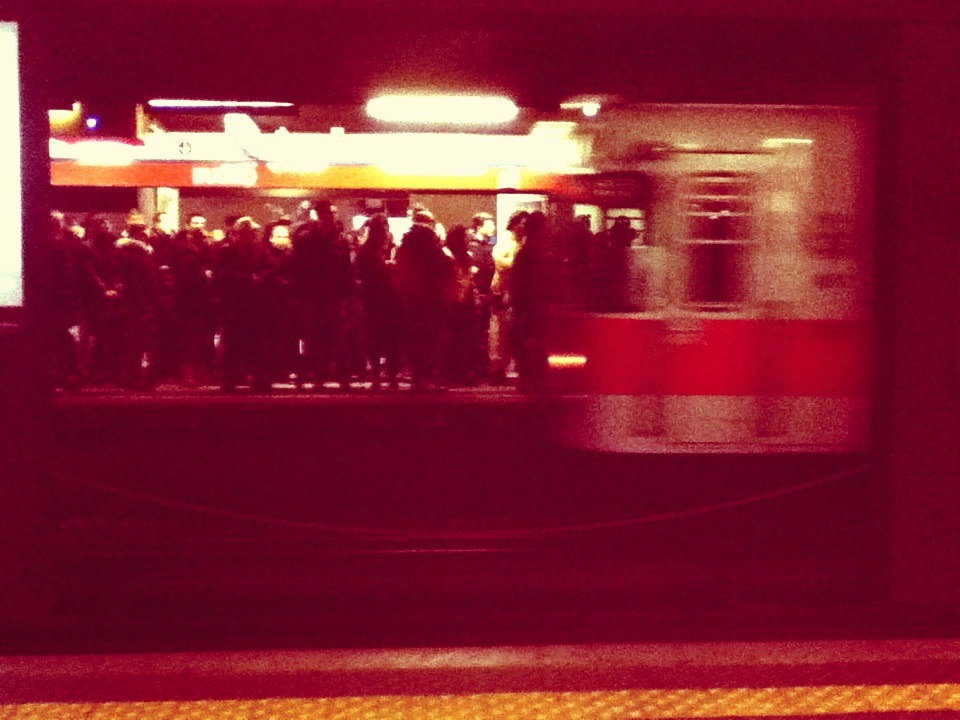
In some cases, you want the moving vehicle in the shot, like this one of the Milan subway I captured with my iPhone camera. This was my first outing with the camera, and I was just getting used to the delay. I was fascinated by the crowd on the other side of the subway platform and thought it would be a great shot to have the crowd behind the train pulling into the station, so I practiced with a couple of shots of the crowd to get the framing and camera timing down. Then, when I heard the train coming, I was ready to click as soon as it entered the frame and captured the image I wanted.


The light this particular evening in the Venetian Lagoon was spectacular. I took several images of the sky but knew the shot would be more interesting with a boat in the foreground. I had my exposure and composition dialed in, it was just a matter of waiting for the right opportunity to come along. When this boat came by, I was ready and waiting to click.


People


We are often surrounded by our fellow human beings, and depending on the shot you want, that can be a good thing or a bad thing. You might think that Europe is an empty place, from my photographs. I really love to capture an empty street or place, to allow the viewer room to imagine themselves in the frame. To do this, I often have to wait for a lull. Just like cars, the flow of people will change, but it's less predictable. Here is another in my market/wheels series, captured in Bologna. It looks like this was a deserted street, but this was a busy Saturday afternoon, the weather was nice, and people were out on the streets in force. I used the times when there were people coming by to set up the shot and play around with composition. When I found the image I wanted, I waited for the people to leave the frame, and clicked.


Here is another image where I waited for the frame to clear, with the exception of the people seated on the left. Evening at the Roman Baths in Bath, England is certainly quieter than the day, but there were still many people wandering around and listening to their audioguides. (I've learned to dislike audioguides - people stand immobile for minutes on end gazing at something while listening to the commentary, much longer than they do without the audioguide.) Meanwhile, I patiently waited for them to move on so I could get the right image. 


Often, your image will be enhanced with a person or two in just the right spot. The next two examples, from Cinque Terre and Bath, are images where the mood is further conveyed by the people in the frame. In both cases, I had to wait until the subjects walked into the right light to capture the image.


So far I've shown you empty or mostly empty places - what about crowds? I've learned quite a bit about photographing a crowd over the last couple of years. Capturing a crowd can convey the energy, the hustle and bustle of a place, but it has to be done right. In general, I've discovered that for a good crowd shot, you want to have full bodies - partial people walking into the frame or cutting off feet is distracting. For a generalized crowd, you also want the people to either be small enough their faces aren't easily distiguishable or facing away from the camera. Nothing attracts the human eye quite as much as a face, so your crowd shot can become an unintentional image of a specific person if you're not mindful. Here's a comparison of two images within moments of each other in Madrid. The first shot is one I would consider a nice crowd-in-the-street scene, the second has more crowd distractions.


Crowds ebb and flow, which is a great thing. Unless you are in an insanely crowded place (like Venice at Carnevale), you can usually situate yourself in a good location and wait for the crowd to disperse itself in a way that works for your intended image. This example from Venice (not during Carnevale) was one where I waited for a good crowd position before pressing the shutter.


The Natural Elements


So far I've talked about human elements, but natural elements - such as light and wind - are some of the more changeable features in our world. As photographers, we live for light, so being aware of the light you are working with and how it may change is an important skill. Partly cloudy and windy days can be great days for waiting to click.

The following set of images from Stonehenge show how just a few moments difference on a partly cloudy day can make a huge difference in an image. Watching the light, and waiting to click at the right moment, can pay off big dividends in your images.


You may remember this group of three image from Cascais, Portugal.  This another time when I waited for the right light to click. The sun was going in and out of the clouds, and without the dappled light this image was not the same. I waited for quite a while for the sun to come out from behind the clouds to capture this scene.


For the next example, it was the wind that made a difference. With wind, you sometimes have to wait for a gust or wait between gusts, depending on what you want to capture. In this image of the main street of Murten, Switzerland, I had to wait for the breeze to die down so that the flags were hanging straight and clearly visible. A subtle detail, but one that means the difference between you being able to tell the location by looking at the image or not.


I've shown you a lot of examples where my patience paid off, but also realize that waiting to click doesn't always work out. There are times when the elements don't change as you predicted. There are times when you can't wait as long as you like - the people you with are impatient or you have someplace to be at a certain time. But when you are aware of your environment, seeing the opportunities and waiting to click - sometimes magic happens. 

Wait for it...
Wait for it...
Click.


I can't wait to see the images you captured by Waiting to Click, new or archive shots are welcome. Link your images in below or put them in the Flick pool. If you have the opportunity to comment on how you set up the shot and waited to click, that would be fun to read. I would love it if you want to add my button to your post, you can find the code here.

Sunday, July 18, 2010

The Same but Different

Farmer's Markets all over the world are the same aren't they? Tables with yummy fruit and vegetables, fresh from the farm, and people who are part of their growing are selling them. In a way, the markets bring us closer together. Closer to our food, without it just showing up magically in a supermarket in the refridgerated section under flourescent lights, you get a better idea of where it's coming from. Who is growing it. They also bring us closer together culturally, it's a familiar experience to visit a market and see the day's wares available to sell. It's an equalizer, every one has to eat. And that food comes from the same place - the land, the sea.

But you also get to see the little differences. Maybe a fruit or vegetable or flower you aren't familiar with. Maybe it's mostly fish instead of other types of meat. The signs for the names or currency are different. Or in the case of this market in Split, Croatia, you see that each woman has a little table for their fruit and vegetables, all lined up in a row, instead of the big truckload farm stands. You see the women who look like they have worked the land for most of their life. The people who, by their existence, would ensure we would eat well here in this country.

Bringing me just a little closer to the place we are visiting. Markets are amazing things.