Showing posts with label Madrid. Show all posts

Wednesday, April 6, 2011

Exploring with a Camera: Waiting to Click

Exploring Patience in Photography 3


Welcome to Exploring with a Camera! This next couple of weeks we are going to be Waiting to Click. As always, I have a lot of ideas to share with you in this post and then there is a link up at the bottom for you to share your images on the topic. You can also share your photos in the Flickr pool if you are interested in being featured on the blog.

There is so much of our world that is changeable. When you tune in to it, you begin to notice the ebb and flow of life around us. "Waiting to Click" is about being aware of the changeable things in our environment, predicting what is going to happen and then waiting to capture the image we've anticipated. So often photographers talking about being ready, having the camera with us and available to shoot, in order to capture a fleeting moment as we see it unfold. Waiting to Click takes the readiness a bit further, adding a bit of both prediction and patience into the mix.

To get a great image by Waiting to Click requires your active participation. Here is what you have to do:
  1. Be aware of what is changeable in your environment. We live in a world of change, whether it's the flow of traffic or the clouds blowing by, there are variables that affect the potential for us to make good images. By noticing the things that are moving and changing, and how they change relative to the things that are fixed, we can make use of them in our photography.
  2. See the image you want to capture. You need to see the potential shot. This may mean looking through or past the changeable things in the environment, or predicting their behavior to include them in the image you want to capture. 
  3. Know your equipment. In order to take advantage of a changing situation, you have to know your camera. What is the delay between shutter press and release? What is the timing if you use burst? I know we are talking about fractions of a second here for dSLRs, but those fractions of a second may matter. For point-and-shoots or phone cameras, the delay is longer and you really have to be able to coordinate the pressing of the shutter with the prediction of the shot.
  4. Wait for the shot to unfold, then capture it. This is the key. This could mean waiting for several seconds, or it could mean waiting minutes. Professional photographers might wait all day for the perfect light to capture the image they see. How long you are willing to wait is up to you.
Now let's see a few examples of Waiting to Click, to further explain what I mean...

Moving Vehicles


Vehicles of all sorts are always moving around us, when we are out and about in the streets. You may recognize the lead-in image for this post as another in my emerging market/wheels series, and the capture of this shot is a great example of Waiting to Click. I saw this image across a very busy street in Siracusa, Sicily. I paused for a while and watched the traffic flow. There were a few moments in each traffic light cycle, where the cars passing by on the street cleared out just long enough to photograph a few frames. While traffic was going by, I looked at possible angles and compositions, and situated myself in the best spot for the image I envisioned. I waited for the next traffic light cycle, and the moment the cars cleared out, I got the shot.

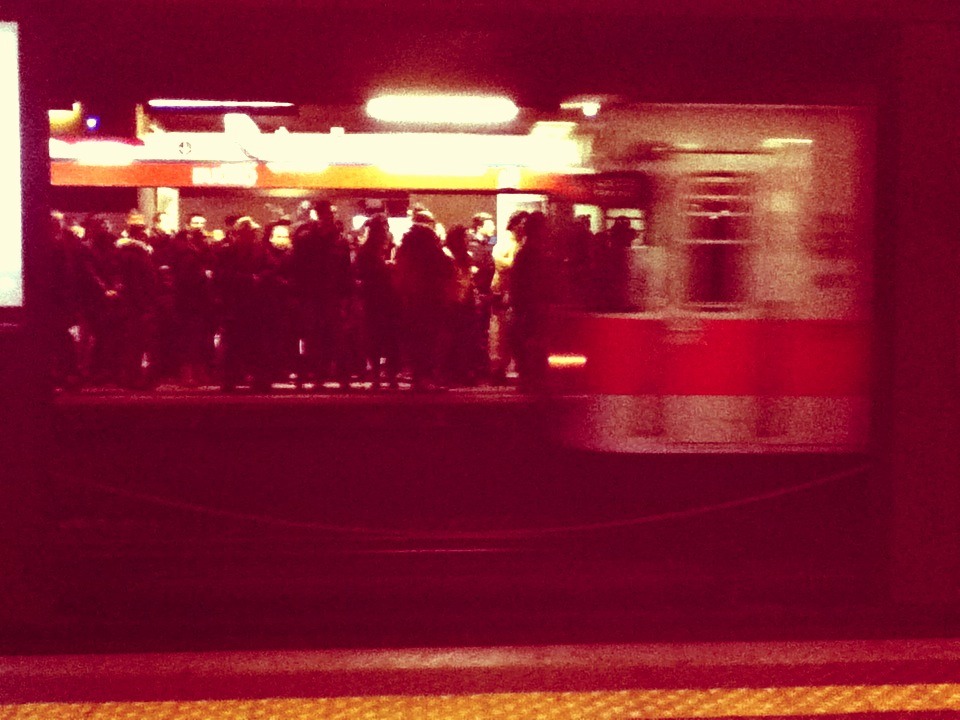
In some cases, you want the moving vehicle in the shot, like this one of the Milan subway I captured with my iPhone camera. This was my first outing with the camera, and I was just getting used to the delay. I was fascinated by the crowd on the other side of the subway platform and thought it would be a great shot to have the crowd behind the train pulling into the station, so I practiced with a couple of shots of the crowd to get the framing and camera timing down. Then, when I heard the train coming, I was ready to click as soon as it entered the frame and captured the image I wanted.

The light this particular evening in the Venetian Lagoon was spectacular. I took several images of the sky but knew the shot would be more interesting with a boat in the foreground. I had my exposure and composition dialed in, it was just a matter of waiting for the right opportunity to come along. When this boat came by, I was ready and waiting to click.


People


We are often surrounded by our fellow human beings, and depending on the shot you want, that can be a good thing or a bad thing. You might think that Europe is an empty place, from my photographs. I really love to capture an empty street or place, to allow the viewer room to imagine themselves in the frame. To do this, I often have to wait for a lull. Just like cars, the flow of people will change, but it's less predictable. Here is another in my market/wheels series, captured in Bologna. It looks like this was a deserted street, but this was a busy Saturday afternoon, the weather was nice, and people were out on the streets in force. I used the times when there were people coming by to set up the shot and play around with composition. When I found the image I wanted, I waited for the people to leave the frame, and clicked.


Here is another image where I waited for the frame to clear, with the exception of the people seated on the left. Evening at the Roman Baths in Bath, England is certainly quieter than the day, but there were still many people wandering around and listening to their audioguides. (I've learned to dislike audioguides - people stand immobile for minutes on end gazing at something while listening to the commentary, much longer than they do without the audioguide.) Meanwhile, I patiently waited for them to move on so I could get the right image. 


Often, your image will be enhanced with a person or two in just the right spot. The next two examples, from Cinque Terre and Bath, are images where the mood is further conveyed by the people in the frame. In both cases, I had to wait until the subjects walked into the right light to capture the image.


So far I've shown you empty or mostly empty places - what about crowds? I've learned quite a bit about photographing a crowd over the last couple of years. Capturing a crowd can convey the energy, the hustle and bustle of a place, but it has to be done right. In general, I've discovered that for a good crowd shot, you want to have full bodies - partial people walking into the frame or cutting off feet is distracting. For a generalized crowd, you also want the people to either be small enough their faces aren't easily distiguishable or facing away from the camera. Nothing attracts the human eye quite as much as a face, so your crowd shot can become an unintentional image of a specific person if you're not mindful. Here's a comparison of two images within moments of each other in Madrid. The first shot is one I would consider a nice crowd-in-the-street scene, the second has more crowd distractions.


Crowds ebb and flow, which is a great thing. Unless you are in an insanely crowded place (like Venice at Carnevale), you can usually situate yourself in a good location and wait for the crowd to disperse itself in a way that works for your intended image. This example from Venice (not during Carnevale) was one where I waited for a good crowd position before pressing the shutter.


The Natural Elements


So far I've talked about human elements, but natural elements - such as light and wind - are some of the more changeable features in our world. As photographers, we live for light, so being aware of the light you are working with and how it may change is an important skill. Partly cloudy and windy days can be great days for waiting to click.

The following set of images from Stonehenge show how just a few moments difference on a partly cloudy day can make a huge difference in an image. Watching the light, and waiting to click at the right moment, can pay off big dividends in your images.


You may remember this group of three image from Cascais, Portugal.  This another time when I waited for the right light to click. The sun was going in and out of the clouds, and without the dappled light this image was not the same. I waited for quite a while for the sun to come out from behind the clouds to capture this scene.


For the next example, it was the wind that made a difference. With wind, you sometimes have to wait for a gust or wait between gusts, depending on what you want to capture. In this image of the main street of Murten, Switzerland, I had to wait for the breeze to die down so that the flags were hanging straight and clearly visible. A subtle detail, but one that means the difference between you being able to tell the location by looking at the image or not.


I've shown you a lot of examples where my patience paid off, but also realize that waiting to click doesn't always work out. There are times when the elements don't change as you predicted. There are times when you can't wait as long as you like - the people you with are impatient or you have someplace to be at a certain time. But when you are aware of your environment, seeing the opportunities and waiting to click - sometimes magic happens. 

Wait for it...
Wait for it...
Click.


I can't wait to see the images you captured by Waiting to Click, new or archive shots are welcome. Link your images in below or put them in the Flick pool. If you have the opportunity to comment on how you set up the shot and waited to click, that would be fun to read. I would love it if you want to add my button to your post, you can find the code here.

Friday, February 11, 2011

The Protector


I'm not a big one for photographing monuments or recreating great photos of historic places. I like to focus in on the details, like this angel atop a building in Madrid. This angel is strong and confident. It looks like he takes his job of protection very seriously, ready to intervene at  moment's notice. Wouldn't you all like to have a guardian angel like that? I certainly would!

PS - Do you see what I see in this photo? The Rule of Thirds!

Monday, January 24, 2011

Capture the Sky


I have been fascinated with skies lately. Whenever I am out and about, I find myself capturing a few images of mostly sky. Maybe just a little bit of something else, to ground the image, like this tree in silhouette.

There is so much possibility in the sky. It's wide open, too big to capture it all with the camera. I can only capture little glimpses, enough to give an impression. The glimpses are so fleeting, as the sky is ever changing. The clouds and the light do not hold for any photographer, I have to catch what I can.

I am once again reminded of the Spiral of Creativity by this image of the sky. We do the best we can to capture the fleeting inspiration that comes to us, and pull it into our spiral. We figure out how to make this transitory and insubstantial thing, this idea, into something real. For all of the giant, expansive nature of ideas, we have to break them down. Frame them into something manageable in order to proceed.

Turn an idea into a manageable plan. Capture a piece of the sky. It's all the same thing, and about as easy to do either. Yet, I am challenged to continue trying. Maybe, just once in a while, something great comes out of the effort. Something I can share with you.

Monday, January 17, 2011

A Store for Joy


New Year's Day has got to be one of the most quiet days in any European city. Here is a shopping district in Madrid, midday on the first of January. Wow. Great for my street photography, since I like these empty places, but a bit surreal. The only people we saw wandering around the city on this day were other tourists.

This sign caught my eye - notice it says "Joyeria." In Italy, many store descriptions end in "-eria." Gelateria, pizzeria, cartoleria to name a few. I know that "joyeria" in this case means jewelry store (gioielleria in Italian), but I loved the idea of a store for joy. If you're a little short on joy, having a bad day, you can stop in and get a boost. Maybe find the perfect gift for a friend going through a rough patch. Kind of a fun idea, don't you think? What would your Joyeria have for sale?


Today I also want to give a quick shout out for the Creative Every Day 2011 Challenge. This is a low pressure, open ended challenge for any type of art and creativity. There are monthly themes, but they are totally optional. I love the idea behind it - it's not about having some BIG CREATIVE GOAL, it's about just being creative every day in some way. For me, that could be taking a photo, or writing a blog post, or reviewing old photos. There is a link up every Monday and you will find artists of all kinds participating - writers, photographers, painters, paper crafters, poets, musicians. I have found many interesting blogs and people through participating last year, and am continuing this year. I thought you all might find it interesting too.

Sunday, January 16, 2011

A Room with a View


Our hotel in Madrid was in a wonderful location, right on Gran Via and a block from the Callao subway stop. Not only was the location great, but we had a wonderful view. We were right on the corner of the building with a wraparound balcony. How cool is that? I loved being able to capture this bustling street at night, from above. Car lights, holiday lights, store lights. Night is when this town comes alive. The streets are crowded, the stores are open late, and the restaurants are hopping. Restaurants don't even open until 8:30pm for dinner. And we thought things started late in Italy!

Staying up late is not my normal mode of operation, although I've stretched from turning into a pumpkin at 10pm to around midnight since we've moved to Italy. My work schedule, and the culture, required a shift. It's been good for me, seeing more of the world at night. I would have completely missed out on the energy and light at night without this experience. I'm so grateful!

Friday, January 14, 2011

A Scene from the City


A scene from Madrid, shot from the top of a City Sightseeing bus. We like riding these sightseeing busses, we get a little bit of history with the audio commentary and see parts of the city we wouldn't otherwise see on foot. We aren't stuck on them all day, since we can get off and on anytime we want. They are the best when the weather is nice and you can sit on the open top for a really good view. We first rode one at Brandon's request but now we all agree on riding them when time is available and the weather cooperates.

Even though these busses are fun, but they make taking photographs challenging. With the movement and angle and obstructions of people and bars and whatever is on the street, I rarely get a good photo. But today, I found a good one. There are so many things I like about today's photograph - the clear focus on the sign and the woman coming out of the metro compared to the out of focus crowd. The odd angle and blurring show spontaneity and motion. There are also many elements of place in this photo - the clearly readable metro sign, the streetlight, taxi sign, and crowd at the crosswalk. Add in the graffiti, buildings and sidewalk in the background. They all scream "city." And not just any city, but big city, European city and probably even Spanish city if you recognize the language.

Do you get all of that from the photograph too? Or am I just adding the context I have in my head? I'd be interested to know what this photograph says to you.

Thursday, January 13, 2011

Exploring with a Camera: Linear Perspective


I am so excited to share a new Exploring with a Camera today! The topic of Linear Perspective has been rolling around in my head since December for a new exploration, and I'm happy to let it free this morning.

Perspective is such a cool compositional concept! It takes advantage of how we see, the optical effects of lines over a distance. I remember learning the concept of perspective way back in my early art classes: Lines, when viewed across a distance, will converge to a vanishing point. Below is an example, from the Barcelona subway. If you were to continue all of the light lines in this photo, they would all meet somewhere at the edge of the tunnel. The perspective of the converging lines brings your eye right through the photo toward the vanishing point in this case.


When drawing, you need to make sure that your lines converge correctly or the drawing will look odd to the eye. In photography, we don't have to worry about "making" the lines converge - they do that already - we can just take advantage of the effect. I'll give you a few examples and variations on how to use linear perspective in your photographs.

Distance


To use perspective bring a sense of depth, include a long distance in the photograph so that the lines can converge more dramatically. This often means using a wide angle (smaller focal length, i.e. 24mm) instead of a zoom (longer focal length, i.e. 100mm), so that you capture the length of the diminishing lines. In the photo below from the Italian Alps, the diminishing lines of the fence give a sense of dramatic depth even though my depth of field (how much is in focus) is actually quite shallow. If I were zoomed in on the fence without the long lines moving into the distance, the photo would have a completely different feel.


Orientation


The orientation of your photograph, horizontal (landscape) versus vertical (portrait), will change how perspective effects the image. In the two examples below from Parco di Monza, note how the horizontal image emphasize the lines of the path while the vertical image emphasizes the height of the trees. Both use the diminishing perspective of the path and the trees, but in different ways. Placing a figure just about in the vanishing point makes for an interesting place for your eye to rest as it moves through the photo.


Composition


You can use linear perspective in so many different ways to get good composition - this is the really fun part! You can move the vanishing point in a photo to get dramatically different effects. Look closely at the examples above and below to see how the diminishing lines are used compositionally.

The photo below is from the Royal Palace in Madrid. The composition is very symmetric, with the lines converging in the center between the left and right. It is not symmetric from top to bottom, however. The focal point of the end of the hall is around the bottom third of the photo.


Here is another photo, this time from Amsterdam, with a left to right symmetry of the linear perspective.


This image from Parco di Monza is interesting - the perspective is symmetric left to right, but the leaf (the real subject) is not centered. The perspective here is not the focal point of the photo, it's the backdrop for the leaf, but it certainly makes the photograph more interesting.


While a symmetric perspective can certainly bring a sense of peace and order to a photograph, linear perspective certainly doesn't have to be used symmetrically. This image from the Berrardo museum in Lisbon, Portugal is more asymmetric in it's lines.


Putting the vanishing point at the edge or corner of an image can make it very dynamic. I love the way all of the lines converge in the corner of this photo from Paris. The contrast of the repeating pattern of the fence provides an interesting counterpoint to the linear perspective. I've noticed in many of my photographs using perspective I also use repeating patterns, a topic I covered in an earlier Exploring with a Camera post.


You can also vary the point of view and effectively use converging lines. The lead in photograph of windows in Madrid or the skyscraper from Barcelona below are two examples of linear perspective looking up. The skyscraper below has an asymmetric composition while the Madrid window image at the top of the post is symmetric left to right. (I seem to like that composition!)


Isn't this fun? Take a look at the world and your photos this next week with an eye toward linear perspective. You can come back next Thursday to link in and Share Your View. I can't wait to see what you find!

If you would like a button to put on your blog to show your participation, you can find the code to copy and paste here. If you are participating in a 365 or 52 project, I hope you will also share Exploring with a Camera in these groups. A little creative inspiration can really help in a long haul project over the course of the year.

See you all soon!

Tuesday, January 11, 2011

Reading the World Book


The world is a book and those who do not travel read only one page. 
– St. Augustine

We arrived home late last night (early this morning, actually) from our week long trip to Madrid, Spain and Lisbon, Portugal. I must say this every time I get back from a trip to a new place, but my head is swirling! It is filled with new foods and experiences and sights and ideas. In the first moments home, the first blog post after I return, it is almost overwhelming to figure out where to start with images and writing. 2111 images captured. 3 major art museums, 4 additional art exhibits, so many historic and cultural sights, countless hours wandering. I sometimes feel like I've been cramming for a final with all of this travel. Reading as many pages in St. Augustine's world book as I can before we move home in July.

Today I'm starting with the beginning of the trip, because it's the best place to start while all of my images download to the computer. A little taste of tapas, a glimpse of the wonderful bar food from Madrid. Doesn't it look yummy? Well, maybe not for breakfast (if you are reading this in the morning) but I can assure you that it was very yummy! Add a glass of Sangria, and you just might have a little piece of heaven right here on earth.

So, with that I'm back. A few more places visited, a few more flavors sampled, a few more pages of the world book read. It will be fun to sort out my swirling experiences in the next couple of weeks, and see what I find.